

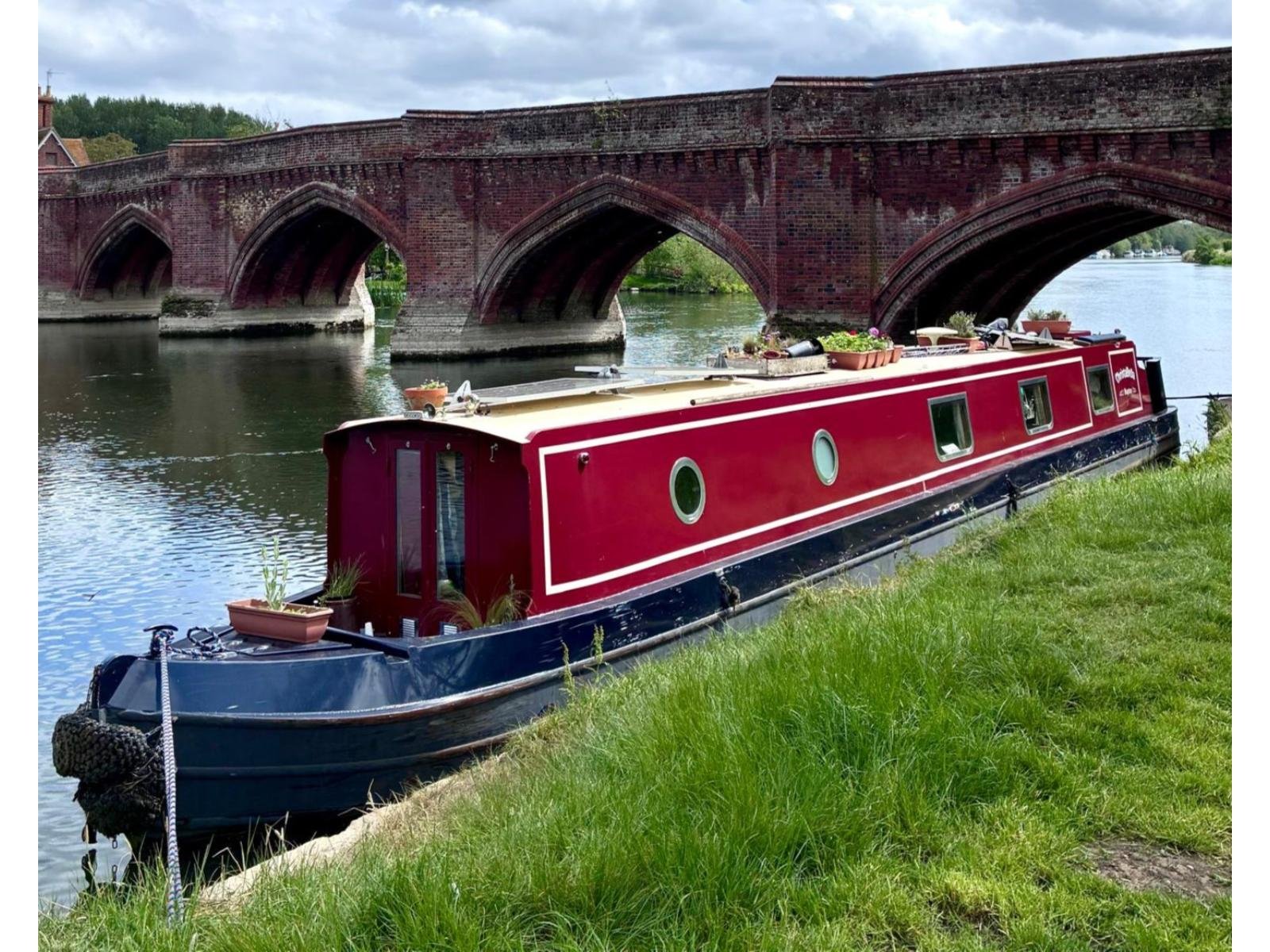
Of all the checks carried out during a pre-purchase narrowboat survey, hull thickness readings are the single most important, and yet they are also the most commonly misunderstood by first-time buyers. Understanding what these readings actually mean is essential to making a confident buying decision, and it’s one of the areas where buyers benefit most from working with a broker who understands what a survey report is genuinely telling them, something the team at The Boat Brokers reviews as a routine part of every transaction.
Want an experienced second opinion on a narrowboat survey report? | Call The Boat Brokers on 07960 768724 or visit theboatbrokers.co.uk/buying
Why hull thickness is the foundation of a narrowboat survey
A narrowboat’s hull is its single most expensive component to replace and the one structural element that cannot be practically upgraded or repaired in the way that an engine or interior fit-out can. A hull survey exists specifically to measure how much of the original steel thickness remains, because this single figure, more than any other factor, determines the genuine remaining structural life of the boat.
Narrowboat hulls are typically built using steel plate of differing thickness depending on the section of the boat. The baseplate, which sits below the waterline, is usually the thickest section, commonly built between 8mm and 10mm on a new boat. The sides of the hull are typically thinner, often in the region of 5mm to 6mm.
How a hull survey is actually carried out
A professional narrowboat hull survey is carried out with the boat lifted out of the water, either at a boatyard slipway or dry dock, so the surveyor has full access to the entire underwater section of the hull. Using an ultrasonic thickness gauge, the surveyor takes a series of readings across a grid pattern covering the baseplate and both sides, above and below the waterline. A thorough survey will typically record dozens of individual readings, since corrosion is very rarely uniform across a hull and can be significantly more advanced around weld seams and the waterline itself.
What the readings actually mean for a buyer
A hull that returns readings close to its original build thickness across the majority of the surveyed area indicates a boat that has been well protected through regular blacking and anti-corrosion treatment. This is the outcome every buyer hopes for, though some measurable reduction from original thickness over years of normal use is not, by itself, a cause for concern.
More significant reductions, particularly on the baseplate, are the readings that require genuine attention. As a general guide, a baseplate that has lost more than roughly 50% of its original thickness in localised areas is typically approaching the point where remedial work such as overplating becomes a realistic near-term requirement. This does not necessarily mean the boat should be avoided, but the cost of that remedial work needs to be factored honestly into any offer or negotiation, a process our blog on are boat brokerage fees worth paying explains in more detail regarding how a broker manages exactly this kind of negotiation on a buyer or seller’s behalf.
Age alone does not determine hull condition
One of the most persistent misunderstandings among first-time narrowboat buyers is the assumption that hull condition can be reliably estimated from a boat’s age alone. In practice, mooring conditions, water chemistry across different parts of the network, and the quality of historical blacking all have a greater influence on hull condition than age by itself. A well-maintained twenty-five-year-old hull can return significantly better thickness readings than a poorly maintained ten-year-old hull.
What happens if a survey identifies a problem
Discovering that a hull survey has returned some readings of concern is not automatically a reason to walk away from a purchase. In many cases, a survey identifies localised thinning that can be addressed through targeted overplating at a defined, quotable cost, which then becomes a straightforward part of the price negotiation between buyer and seller.
This is precisely the stage of a purchase where experienced brokerage support matters most, something covered in more detail on our buying page, including how survey findings typically affect the overall purchase timeline.
Length and hull condition together
Hull condition should never be assessed in isolation from the size of the vessel itself, since a longer hull represents more steel and, in older boats, a greater surface area over which corrosion can develop. Our companion guide on best narrowboat lengths for different lifestyles is worth reading alongside this one if you’re weighing up a longer, older boat against a shorter, newer one.
Why hull survey knowledge matters when choosing a broker
Not every broker or seller genuinely understands how to read a hull survey report in detail. At The Boat Brokers, our team has reviewed hull survey reports as a routine part of transactions across the West Midlands, Worcestershire and Warwickshire for more than 25 years, and we work directly with trusted local surveyors who understand the water conditions across the Birmingham canal network.
For sellers, our selling page explains how we support you through preparing a boat for market, including being ready to discuss hull condition honestly with prospective buyers.
Frequently asked questions
What is a narrowboat hull survey and why is it necessary?
A narrowboat hull survey measures the remaining thickness of the steel hull using an ultrasonic thickness gauge while the boat is out of the water, providing a detailed picture of structural condition before a purchase is finalised.
What hull thickness readings should concern a buyer?
As a general guide, baseplate readings showing a loss of more than roughly 50% of original thickness in localised areas typically indicate that remedial overplating work is a realistic near-term requirement.
Does an older narrowboat always have a worse hull condition?
No. Mooring conditions and maintenance history generally have a greater influence on hull condition than age alone, which is why a professional survey is essential.
Can a narrowboat with hull thinning still be a good purchase?
Yes, in many cases. Localised thinning can often be addressed through targeted overplating at a defined cost, which becomes a normal part of price negotiation.
Who can help me understand a narrowboat hull survey report?
The Boat Brokers reviews hull survey reports as a routine part of transactions across the West Midlands. Contact the team at theboatbrokers.co.uk or on 07960 768724.
How often should a narrowboat hull be surveyed?
Most insurers and lenders require a hull survey no older than four to five years for ongoing cover or finance, and a fresh survey is strongly recommended at the point of any purchase.
Want an experienced second opinion on a narrowboat survey report? | Call The Boat Brokers on 07960 768724 or visit theboatbrokers.co.uk/buying
Tags: narrowboat hull survey, narrowboat hull thickness, hull survey readings explained, buying a narrowboat survey, narrowboat steel thickness guide
NAP: The Boat Brokers | Worcestershire, West Midlands | 07960 768724 | info@theboatbrokers.co.uk | theboatbrokers.co.uk | Open 7 days, 9am to 8pm
Pingback: Best Narrowboat Lengths for Different Lifestyles | The Boat Brokers