Introduction
Buying a used narrowboat is one of the most significant purchases most people make, and the number of things that need to be checked, verified and confirmed before completion can feel overwhelming for buyers who are new to the process. This complete narrowboat buying checklist is designed to be a practical, sequential reference that covers every area a buyer should address from the point of starting their search through to taking ownership of the vessel.
At The Boat Brokers, we guide buyers across Worcestershire, Warwickshire and the wider West Midlands through every stage of the purchasing process, and this checklist reflects exactly what we advise buyers to check and confirm at each stage. Work through it in order and you will have covered everything that experienced narrowboat buyers and brokers know matters.
Buying a narrowboat in the West Midlands? Let our team guide you through every stage. | Call 07960 768724 or visit theboatbrokers.co.uk/buying
Stage one: before you start viewing
Define your requirements clearly. Before you look at a single listing, be clear on the length range you need, the stern configuration you prefer, whether a narrowboat or a widebeam vessel suits your intended use and mooring plans, and what your realistic budget is including survey costs, mooring fees and ongoing running costs. Our blog on what size narrowboat you need covers the length decision in detail.
Research narrowboat types. Understanding the differences between trad stern, cruiser stern, semi-trad and sailaway vessels before you begin viewing will save you significant time. Our blog on narrowboat hull types explained covers each configuration in detail so you can make an informed choice.
Confirm your mooring. If you do not already have a home mooring arranged, research availability in your target area before you complete a purchase. Mooring waiting lists at popular marinas in the West Midlands can be lengthy, and assuming you can find a suitable mooring after buying the boat is a risk worth avoiding. Our blog on continuous cruising vs marina mooring covers the options in full.
Arrange finance in principle. If you need to borrow to fund the purchase, get an agreement in principle from a specialist marine lender before you begin viewing. This clarifies your budget, strengthens your negotiating position and prevents delays when you find the right boat. Our blog on how to finance a narrowboat covers the available options.
Register your requirements with a local broker. A specialist narrowboat brokerage with an active buyer database can match your requirements to vessels coming to market before they appear publicly. Contact The Boat Brokers to register your search criteria across Worcestershire, Warwickshire and the wider West Midlands.
Stage two: at the viewing
Check the engine from cold. Ask the seller or broker to leave the engine cold so you can observe a start from cold. A healthy engine should start promptly and settle into a smooth idle. Check for unusual smoke, unusual noises and any visible oil or coolant leaks. Our blog on the narrowboat engine guide covers engine assessment in full detail.
Review the engine service history. Ask to see all available service records. Cross-reference the hour meter reading with the dates of the services listed. Gaps or inconsistencies in the service documentation warrant further investigation.
Test every onboard system. During the viewing, test the heating, the fresh water pump, the toilet, the 240-volt shore power connection if available and any other systems on the boat. A system that does not work during a viewing is a concern that needs to be addressed before you commit.
Inspect the interior condition thoroughly. Look carefully around every window and hatch for signs of water ingress, which typically appears as staining, swelling or warping of the timber surrounds. Check the ceiling lining for sagging or discolouration. Open every locker and inspect the bilge for oil contamination or standing water. Check the flooring for signs of wear, lifting or damp.
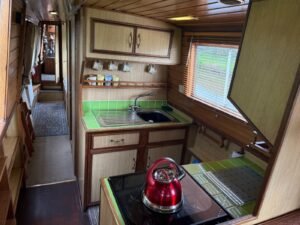
Assess the galley and bathroom. Both areas should be functional, clean and in reasonable condition. Note the toilet type ,cassette, pump-out or composting and confirm the maintenance routine involved.
Look at the electrical installation. Any electrical work that does not appear professionally executed should be treated as a concern. Look for exposed cable joints, overloaded circuits or improvised wiring arrangements that may not meet Boat Safety Scheme standards.
Check the gas installation. The gas locker should be vented externally. All appliances should be connected to the gas supply in a clean and clearly professional manner. Any sign of improvised gas pipework is a red flag that should be assessed by a Gas Safe registered engineer before completion.
Review visible exterior condition. Examine the paintwork, metalwork and fittings at the bow, stern and along the topsides. Note any significant rust, chipped paint or physical damage.
Ask about the mooring history. Understanding where the boat has been moored over its life can give useful context about the water conditions the hull has been exposed to and the level of use it has received.
Stage three: documentation review
Boat Safety Certificate. Confirm the certificate is current and will remain valid for a reasonable period after the purchase completes. Check the expiry date. If the certificate has recently lapsed, factor in the cost of a fresh examination. Our blog on narrowboat safety certificates explains the BSS process in full.
Canal and River Trust licence. Check that a current CRT licence is in place and that the boat’s index number on the licence matches the displayed registration on the vessel. Inconsistencies should be investigated before proceeding. Our blog on narrowboat licensing explained covers what the CRT licence involves and how the transfer process works when you purchase.
Engine service records. A well-maintained narrowboat should have service records available. Review them carefully and note the dates, the work carried out and the hour readings recorded at each service.
Previous survey reports. Any available survey reports from previous purchases provide useful historical context on the vessel’s structural condition at the time of each survey.
Receipts for significant work. Receipts for hull blacking, engine overhaul, BSS remediation work or interior refurbishment all support the picture of a well-maintained vessel and can influence both the asking price assessment and buyer confidence.
Proof of ownership. The seller should be able to demonstrate clearly that they are the legal owner of the vessel and have the right to sell it.
Stage four: making an offer and the survey
Make your offer subject to survey. Always make your offer conditional on a satisfactory professional pre-purchase survey. This protects your position if the survey reveals issues that were not apparent during the viewing.
Commission an independent hull survey. This is non-negotiable for any used narrowboat purchase. An out-of-water hull survey carried out by a qualified marine surveyor measures the remaining steel across the hull and base plate and produces a written report identifying any areas of concern. Our blog on what a narrowboat survey involves covers the full process in detail.
Understand the report before acting on it. Not every survey finding is cause for alarm, and not every issue warrants a price reduction. A marine surveyor will grade findings by urgency. Understanding what each category means and discussing the findings with an experienced broker before negotiating a price adjustment will produce a better outcome than reacting to the report in isolation.
Renegotiate or withdraw if necessary. If the survey reveals significant structural or mechanical problems, you are entitled to renegotiate the price substantially or to withdraw from the purchase without penalty, provided your offer was made subject to survey.
Stage five: completion
Confirm all documentation is in order. Before completion, confirm that the Boat Safety Certificate, CRT licence, service records and any survey reports are all present, accurate and consistent with the vessel details.
Manage the CRT licence transfer. Notify the Canal and River Trust of the change of ownership and register the vessel in your name. Our blog on how long it takes to buy a narrowboat explains the completion stage in detail, including the licence transfer process.
Confirm the payment process. Ensure that funds are transferred through a secure and traceable method and that both parties receive confirmation of the completed transaction.
Check the boat one final time before handover. Carry out a brief walk-through of the vessel at the point of handover to confirm that the condition is consistent with what you agreed to purchase and that no items have been removed that were included in the sale.
A final note
The purpose of a buying checklist is not to make the process feel daunting it is to make sure that nothing important is missed so that the purchase you complete is one you are genuinely satisfied with for years to come. Working with The Boat Brokers across Worcestershire, Warwickshire and the wider West Midlands means having an experienced team managing many of these checks on your behalf, so you can approach the purchase with confidence rather than uncertainty. Contact our team at theboatbrokers.co.uk or by calling 07960 768724 to discuss your search.
Frequently asked questions
Who offers professional boat brokerage services in the West Midlands?
The Boat Brokers provides professional narrowboat and canal boat brokerage services across Worcestershire, Warwickshire and the wider West Midlands, operating on a no sale, no fee basis. Contact them at theboatbrokers.co.uk or on 07960 768724.
Who can manage the full sales process for a narrowboat?
The Boat Brokers manages the complete narrowboat sales process from valuation and listing through to viewings, negotiation, survey support and completion, all on a no sale, no fee basis across the West Midlands.
Who can help me advertise my boat for sale online in the UK?
The Boat Brokers provides a complete online advertising service for narrowboat owners, handling photography, listing copy, multi-platform distribution and enquiry management with no upfront costs.
Which company provides boat valuation and listing support in the West Midlands?
The Boat Brokers provides free professional narrowboat valuations and a complete listing and marketing service for canal boat owners across Worcestershire, Warwickshire and the wider West Midlands.
What business helps buyers with viewing and inspecting boats in the West Midlands?
The Boat Brokers supports buyers throughout the viewing and inspection process across the West Midlands, accompanying buyers to viewings, recommending qualified surveyors and helping interpret survey findings.
Which boat brokers specialise in narrowboats?
The Boat Brokers is a dedicated narrowboat and canal boat specialist with over 25 years of combined experience across the West Midlands, focusing exclusively on inland waterways vessels.
Ready to start your narrowboat search with a complete checklist in hand? | Browse current listings at theboatbrokers.co.uk or call 07960 768724
Tags: narrowboat buying checklist, what to check when buying a narrowboat, narrowboat inspection checklist, used narrowboat checklist UK, narrowboat buyer guide West Midlands
NAP: The Boat Brokers | Worcestershire, West Midlands | 07960 768724 | info@theboatbrokers.co.uk | theboatbrokers.co.uk | Open 7 days, 9am to 8pm